Lead Qualification: Process, Criteria and Examples

Most guides on lead qualification are written for a salesperson on a call, who can hear the buyer and ask anything. This one is for the person who owns the website. Visitors arrive at all hours, and most of them never say who they are. Some fill in a form, some chat, and many leave after a page or two. Then somebody has to decide who deserves a human's time, often from a few form fields and a list of pages viewed.
Below are the criteria to judge a lead on, a seven-step process, the frameworks and stages you will hear about, and how to qualify an anonymous visitor on your site, with a worked example of three visitors.
What is lead qualification, and what makes a lead “qualified”?
Think of a good host at a restaurant. They do not send every person who walks in to the best table. They ask a few quick things: how many of you, do you have a booking, how long can you wait. Then everyone ends up in the right place. Lead qualification is that, for your business.
A lead is anyone who has shown interest and given you a way to reach them. A qualified lead is a lead that also fits your customer profile and looks ready to buy. The others are unqualified, and that does not mean bad. Many are just early.
You will also hear prospect. A prospect is a lead you have decided is worth pursuing. Qualification is the step between the two.
Why does lead qualification matter?
Because buyers do not wait for you. In a Gartner survey of 646 B2B buyers, 67% said they prefer a buying experience without a sales rep (Gartner, March 2026). So your website does most of the first conversation, and a person often joins late.
An earlier Gartner survey, of 632 B2B buyers, found that 73% actively avoid suppliers who send irrelevant outreach (Gartner, June 2025). A wrong call is not free. It uses up a salesperson's hour, and it may close the door on a buyer who would have said yes next quarter. Qualifying first is how you stop being the irrelevant outreach.
What are the criteria for a qualified lead?
Every qualification system is built from two questions. Fit: is this the kind of company and person we sell to? Intent: are they ready to buy soon? Fit changes slowly. Intent can change in a day.
| Criterion | Fit or intent | What to look at | A question you can ask |
|---|---|---|---|
| Company size and industry | Fit | Does the company look like the customers who do well with you? | "About how big is your team?" |
| Role and authority | Fit | Can this person decide, or help decide? | "What is your part in choosing a tool like this?" |
| Need | Intent | Is there a real problem that you solve? | "What are you trying to fix?" |
| Budget | Intent | Is money set aside, or likely to be? | "Do you have a budget range in mind?" |
| Timeline | Intent | Is there a date, or a reason to act now? | "When do you want this running?" |
| Behavior on your site | Intent | Visits to the pricing page, return visits, time spent | None. Watch, do not ask. |
| What they ask you | Intent | Questions about price, setup, contracts or security | None. They are telling you. |
How do you qualify a lead? Seven steps
- Describe your best customer. Look at the five customers who got the most out of you. What do they share? Size, industry, role, the problem they had. That is your ideal customer profile.
- Pick three to five criteria. Choose them from the table above. Not twelve. Every extra criterion is one more thing to collect and one more thing to argue about.
- Collect the signals. Form answers, chat answers and pages viewed. Some of it the visitor tells you. Some of it you simply see.
- Ask a few questions, not all of them. Two or three fit questions, such as company size and role, is enough at first. Read the rest from the conversation, and ask later once someone has a reason to trust you.
- Score and sort. Put every lead into a tier, such as High, Medium or Low, using rules you wrote down. If two people would sort the same lead differently, the rules are not clear yet.
- Hand off with the story. A salesperson who sees what the lead asked and said starts the call halfway down the road. One who sees only a name starts from zero.
- Say no kindly, or say "not yet". Disqualify the ones who will never buy. Put the ones who are early on a nurture list and look again later.
Which qualification framework should you use?
A framework is a list of questions that someone smart already wrote down, so you do not have to start from nothing. Three come up again and again.
| Framework | What it stands for | Best for |
|---|---|---|
| BANT | Budget, Authority, Need, Timeline | Quick checks and shorter sales. A website chat can pick up all four from the conversation. |
| CHAMP | Challenges, Authority, Money, Priorities | Starting with the buyer's problem before you talk about money. |
| MEDDIC | Metrics, Economic buyer, Decision criteria, Decision process, Identify pain, Champion | Large deals with many people involved. Heavy for a first chat. |
For a website, start with BANT, but do not read it out as four questions. Most of it comes out of the conversation itself. A visitor who asks for pricing for 40 people before the quarter ends has told you about need, budget and timing without being asked. Where a signal is missing, a light follow-up question fills the gap. ZipTier reads buying signals the same way, from the chat: purchase, timing, authority, need and budget.
What are MQL, SAL, SQL and PQL?
These are your sorting bins. Different companies draw the lines in different places. What matters is that marketing and sales agree on where each line is.
| Stage | What it means | Who owns it |
|---|---|---|
| MQL, marketing-qualified lead | Has engaged with your marketing: downloaded something, joined a webinar, kept coming back. | Marketing |
| SAL, sales-accepted lead | Marketing passed it on and the sales team agreed to work on it. | Sales development |
| SQL, sales-qualified lead | Checked further. Has a real problem and is ready to talk about price and scope. | Sales |
| PQL, product-qualified lead | Tried the product, for example on a free plan, and got value from it. | Product and sales |
What is the difference between lead qualification and lead scoring?
Scoring ranks. Qualification decides. A score is a number or a label that tells you who to contact first. Qualification is the choice to pass a lead to sales. At any real volume you will use scoring to help you decide. ZipTier uses three tiers: High, Medium and Low.
How do you qualify leads on a website?
On a call, you can see the person and ask anything. On a website, the visitor is anonymous, in a hurry and one click from leaving. That changes the job. Three rules help.
- Give before you ask. Answer their question first. People who got help are more willing to answer back.
- Ask inside the conversation. A form asks ten things at once. A good chat asks one thing at a time, when it makes sense.
- Keep a way out. Let people skip a question, and let them reach a person.
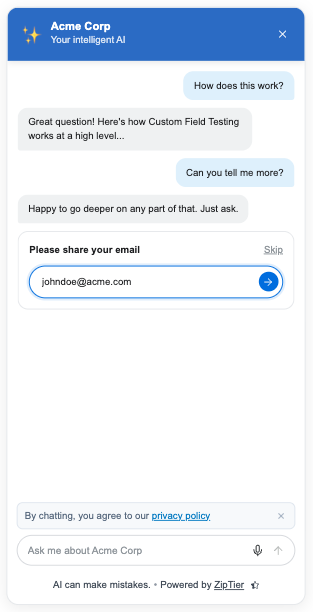
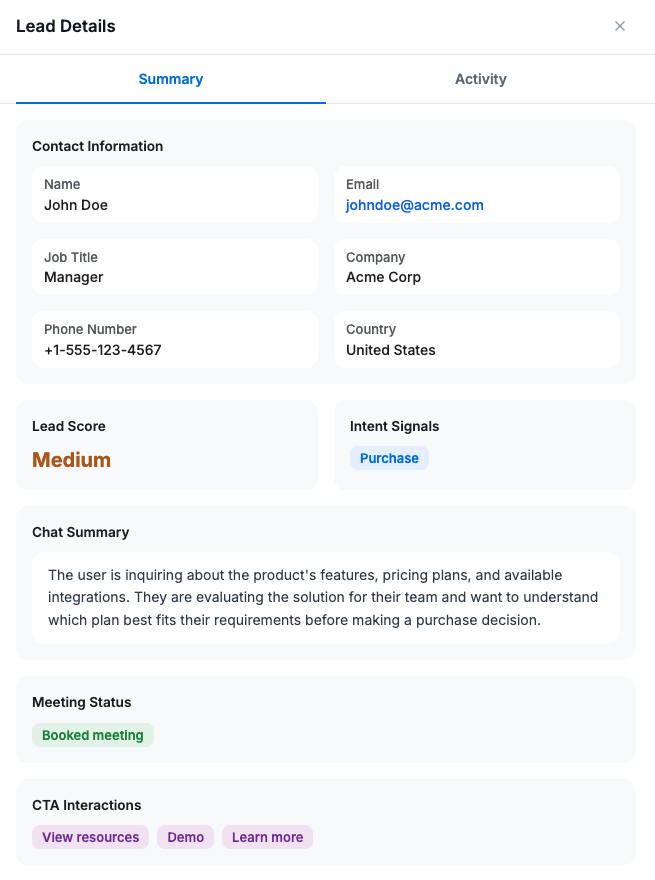
Here is how ZipTier does it. It answers from your own content. As the chat goes on, it asks for contact details inside the conversation, and the visitor can skip. Then it grades the lead High, Medium or Low from two things: fit (the answers to your lead questions) and intent (how ready they are to buy, read from the chat). Your team sees the score, the buying signals, a short summary of the chat and what the visitor clicked.
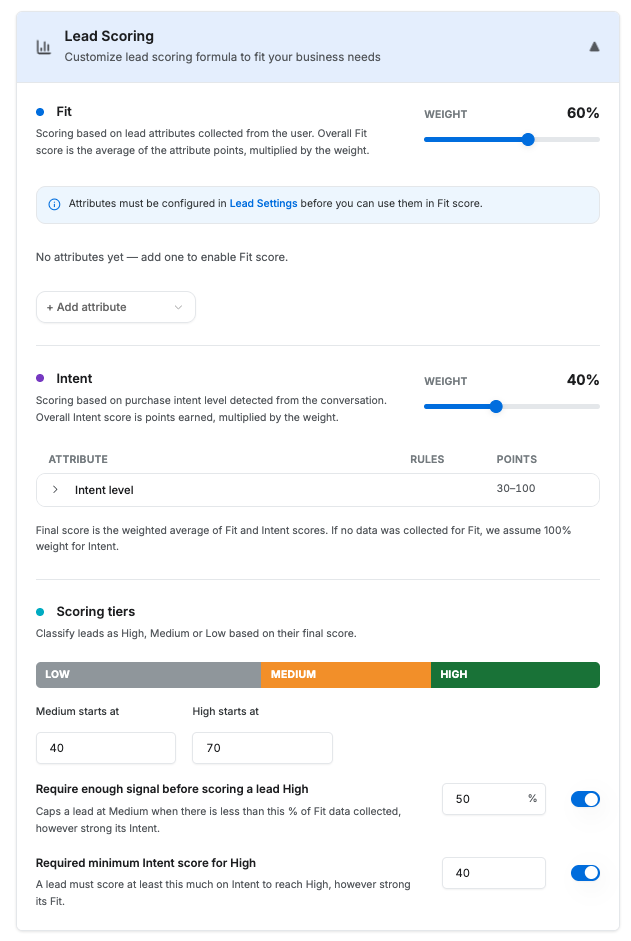
You set the rules. Fit and intent each get a weight, and you choose where Medium and High start. Two guardrails stop weak leads from reaching High: one asks for enough fit information first, and one asks for a minimum intent score.
When a lead lands High, ZipTier checks again about five minutes later. If it still holds, your team gets an email with the details and the buying signals. If you've connected HubSpot, every lead with an email address goes there too, whatever its score. High-scoring visitors can also book a meeting right in the chat.
A word of care. Gartner's 2025 survey also found that buyers prefer a seller's input when they work out whether a product fits their own company's needs (Gartner, June 2025).
So let the assistant answer and sort, and keep a person ready for the buyer who wants to talk through their own situation.
Can AI qualify leads?
Yes. It can ask the screening questions at any hour and never gets tired. It can also answer hard, detailed questions about security, integrations or pricing, as long as the answer is in your content. Where it needs a person is judgment: a buyer who wants to know how your product would work in their own setup, or a question whose answer depends on things your content does not capture.
Comm100's 2026 benchmark shows the gap. Its own AI agent handled 75.3% of incoming chats, and across all industries, AI chatbots fully resolved 44.8% without a person (Comm100).
Those are customer-service chats, not sales chats, and Comm100 sells chat software. Still, the lesson carries over: handling a chat is not the same as finishing it. Whatever tool you pick, keep a clear route to a person.
A worked example: three visitors, one day
Here are three visitors on a software company's site. We invented them. Same website, same assistant, three different outcomes.
"We need pricing for about 40 people and we want this live before the quarter ends."
"How does the HubSpot connection work? We are just looking around for next year."
"What does a chatbot actually do? It is for a class project."
And here they are on the fit and intent map. Visitor A is a good fit and ready now. Visitor B is a good fit but early. Visitor C is neither.
Notice what we did not do. We did not send Visitor C to sales, and we did not ignore them either. They got a good answer. And Visitor B did not go cold. They went on the nurture list, with the chat attached.
How do you disqualify a lead?
Disqualifying is not rude. It saves both sides time. Say it early, say it kindly, and point to something useful, such as a guide or a free tool. The usual reasons are the wrong company size or industry, no authority and no way to reach the person who has it, no problem that you solve, and no reason to act in any reasonable time. Students, job seekers and people doing research belong here too.
Do not delete the “not yet” ones. Put them on a nurture list and look again when something changes, such as a new hire, new funding or a second visit to the pricing page.
A lead qualification checklist
Seven yes-or-no checks you can run on any lead:
- Does the company look like your best customers? Fit
- Is the person a decision maker, or close to one? Fit
- Is there a real problem that you solve? Intent
- Is there a reason to act soon? Intent
- Did they ask about price, setup or contracts? Intent
- Did they come back, or look at the pricing page? Intent
- Can you reach them? Do you have an email or a phone number? Reach
If most answers are yes, send the lead to sales. If the fit answers are yes but the intent answers are not, nurture it. If neither, say a kind no.
Common mistakes
- Asking for too much, too soon. A form with twelve fields asks a stranger to do a lot of work for nothing.
- Judging on job title alone. A "manager" at the right company can matter more than a "director" at the wrong one.
- Qualifying once and never again. People change. A lead who was early in March can be ready in June. Look again.
- Passing a lead to sales without the chat. The conversation is the best note you have. Send it with the lead.
- Letting a bot guess. If it does not know, it should say so and bring in a person.
Frequently asked questions
What qualifies as a lead?
A lead is a person or company that has shown interest and given you a way to contact them, for example by filling in a form or sharing an email in a chat. A qualified lead also matches your customer profile and looks ready to buy soon. The rest are unqualified, which usually means early, not bad.
How do you determine if a lead is qualified?
Check two things: fit and intent. Fit asks whether the company and the person match who you sell to. Intent asks whether they look ready to buy soon, from what they ask, say and do. If both look good, pass the lead to sales. If only the fit looks good, nurture the lead.
What are lead qualification criteria?
Common criteria are company size and industry, the person's role and authority, a real need, a budget, a timeline, and behavior on your site such as visits to the pricing page. Group them into fit (who they are) and intent (how ready they are), and use three to five, not a dozen.
What is the difference between lead qualification and lead scoring?
Lead qualification is the decision to pass a lead to sales. Lead scoring is the ranking that helps you make that decision, as a number or a label. ZipTier scores each lead High, Medium or Low from fit and intent, so your team knows who to contact first.
What is the difference between an MQL and an SQL?
A marketing-qualified lead (MQL) has engaged with your marketing, for example by downloading a guide or visiting often. A sales-qualified lead (SQL) has been checked further, has a real problem, and is ready for a sales conversation. Many teams also use SAL (accepted by sales) and PQL (tried the product).
Can AI qualify leads?
Yes. An AI assistant can answer questions, including detailed ones about security, integrations or pricing, ask a few screening questions, score the answers and give your team a summary. It should answer only from your own content and say when it does not know. Bring in a person when the buyer wants advice on their own situation, or when the answer needs judgment your content does not capture.